Mixcraft 6 for Mac Free Download Updated
Mixcraft 6 for Mac Free Download
The key features of Acoustica's Mixcraft have always been affordability and ease of utilize. Version 6 builds on these strengths but too adds a new Pro Studio edition.
Acoustica's Mixcraft has made several previous appearances in SOS, nigh recently in September 2010 (/sos/sep10/articles/mixcraft-v.htm), when version v came under scrutiny. At present version half dozen has arrived, on offer both every bit a standard bundle and as role of a larger Pro Studio bundle.
To recap, Mixcraft is an audio and MIDI sequencing application capable of hosting third-political party effects and instrument plug-ins, a number of which are included. Information technology provides born tools for manipulating the pitch and tempo of sampled loops, like to those pioneered by Sony's Acid and included in Abelton's Alive and Apple's GarageBand, amidst others. A large sound library is also included. The aim is to provide a user-friendly, self-independent virtual studio equipped for all simply the virtually elaborate production tasks.
Mixcraft is bachelor for Windows only (XP, Vista and 7), with a 1GHz CPU and 2GB RAM as minimum hardware requirements. The standard version of Mixcraft 6 costs an inflation-busting $74.95 (about £47) when bought every bit a download, simply as version v did earlier it, while a boxed edition is bachelor for ten dollars more. If you're already a registered Mixcraft v user, you can upgrade for just $twenty. The Pro Studio parcel is pricier at $149.95 (for a download) and comes with a selection of extra effects not included in the standard package. Given what information technology could cost to purchase a comparable parcel of third-party plug-ins yourself, the price divergence is not outrageous.
Acoustica have made a virtue of Mixcraft's ease of handling and apparent simplicity, trading nether the admirable slogan "Software Should be Easy to Use!" Merely after several rounds of maintenance releases and whole new version number, is information technology still like shooting fish in a barrel to use?
World Of Mixcraft
The boxed Pro Studio package, reviewed hither, contains a single installation DVD and a leaflet with some tips for setting up your audio hardware; the full manual is on the DVD in PDF format, and in that location'due south an online version available at the Acoustica web site. Later on you lot've installed it from the disc, in that location's a good chance yous'll be informed that you're running an outdated version and prompted to download the almost contempo update. Lest this make the installation disc seem rather pointless, acquit in mind that it likewise contains the complete and rather extensive loop and sample library, which would otherwise need downloading too.
I've mentioned GarageBand and Acid already, and Mixcraft is built around a similar unmarried-window, two-pane layout, which remains essentially unchanged in version six. Audio and MIDI tracks occupy the main pane at the acme, while the pane beneath is split across several tabs where smaller details can be viewed and edited. When a part is selected on an audio track, for example, its waveform and associated parameters are automatically displayed in the Audio tab below. MIDI tracks work similarly, although with a piano-roll or score editor in place of the waveform view. The mixer can as well exist accessed in this manner and, in fact, nigh every kind of adjustment can be made in the lower pane, speedily and easily, without losing sight of the larger arrangement in a higher place.
Six Upwardly
Although the layout is fundamentally unchanged, version 6 sees the program's graphics refreshed for a slightly more than upmarket look, and below the surface information technology becomes apparent that small improvements have been made throughout the application. For instance, Mixcraft is now a Rewire host: MIDI sequence data can be used to trigger instruments in connected Rewire applications — which are treated merely similar any other musical instrument, with the resulting audio being channelled back into Mixcraft's mixer. Similarly, Mixcraft now supports unlimited audio outputs for VST Instruments (individual outputs can be added or deleted as required).
A big sound library was already included, and in version 6 this has been expanded to over 6000 loops and sound furnishings, many arranged as 'Song Kits' in a multifariousness of styles. The quality of these is generally good, and there are lots of useful and usable building blocks to choose from. The Library tab also now includes an improved Search characteristic, which works well, and an Import function for adding new loops to the library.
Audio tracks at present include a convenient congenital-in guitar tuner. A single click brings up the tuner interface, which temporarily replaces the level meter for that runway. The name of the nearest note (for example, 'A' or 'G') is displayed, with a 'cursor' indicating how sharp or flat the incoming pitch is relative to information technology.
Dial-in/punch-out recording is some other new improver. Only click the Dial In/Out button, so click and drag in the timeline to create a 'punch expanse' dictating where recorded takes should begin and end. Looped recording is also now possible, with each pass automatically stored every bit a separate clip. Tracks now provide multiple lanes, so that more than ane clip can play simultaneously without them having to exist stacked on top of one another; lanes are automatically created whenever a new take overlaps an existing 1.
Ii uncomplicated utility functions accept been added to the context carte when right-clicking an audio clip: Reverse non-destructively reverses the selected clip (automation envelopes are left in their original positions), while the Phase submenu allows you to invert the polarity of the left aqueduct, the right aqueduct, or both channels. Information technology'southward besides now possible to insert or remove time in a project by dragging a selection in the timeline, right-clicking and choosing either Insert Selected Time or Remove Selected Time from the contextual carte; this is much easier than performing a cumbersome cutting-and-paste operation in the heart of a complicated organisation.
New SubMix tracks (and corresponding mixer channels) can at present be created  Mixcraft half-dozen's mixer now includes SubMix (grouping) channels, among other improvements. , which let the outputs from a group of other tracks to exist routed together via ane fader, EQ, effects chain, and so on. Tracks can be added to a SubMix group simply past dragging and dropping inside the track listing, and the tracks routed to a SubMix runway can exist shown or hidden with a single click. Output Charabanc tracks are similar, and can too be used to group tracks, but offer additional flexibility when using audio hardware with multiple outputs. By routing Output Buses to different hardware outputs you can hands create, for example, split up headphone and monitor mixes. Equally, you could utilize an Output Bus to route signals to an outboard furnishings processor, using a conventional input to render the candy signals to the mix.
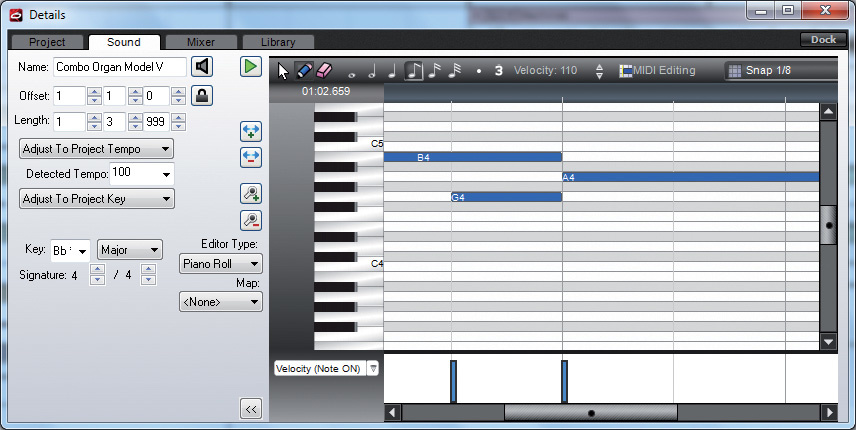 Improvements to the MIDI editor include better quantising and note name display, as shown hither.
MIDI & Video Improvements
Mixcraft'southward MIDI-related features accept likewise been enhanced.The piano-ringlet editor for MIDI clips has been tweaked then that MIDI note names (A3, B2 and so on) now appear superimposed on the notes themselves. Drum maps can at present exist created to display the names of individual drums, instead of annotation names, when triggering drum kit instruments. The annotation editor also sees some improvements, including an automated Tidy Notes function to automatically remove score clutter, and the choice to toggle visibility for unused clefs (Treble & Bass, Treble and Bass are the options).
It's also now possible to route MIDI runway output to furnishings plug-ins, to control a pitch-correction or vocoder plug-in, for example. Mixcraft'due south quantise functions have been developed, too, and at present include options to adapt the beginnings and/or ends of notes, and a Swing parameter. A convenient unmarried-click Humanize tool has also been added, to loosen upwardly the phrasing of programmed parts.
Back up for MIDI control surfaces has been improved. Buttons on an external controller can at present be assigned to Mixcraft's send controls, just as knobs and faders tin be assigned to mixer controls or plug-in parameters. Assignments can be fabricated via a convenient MIDI learn role, and controller maps can be saved and reloaded every bit required.
Mixcraft's video-editing functions have as well undergone further development. 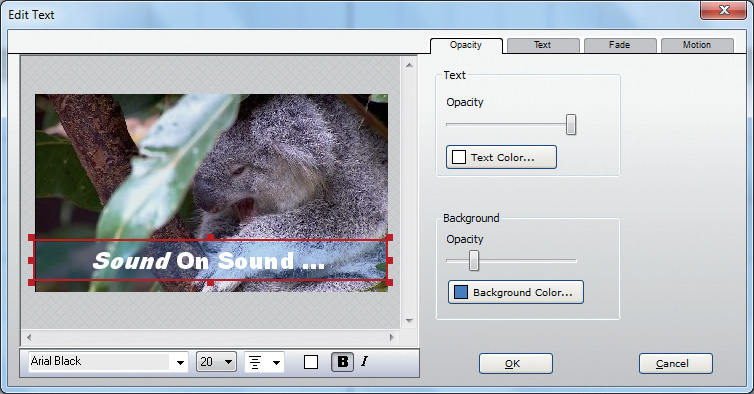 Mixcraft includes uncomplicated but very effective video-editing functionality, including the ability to create montages of still images. It's at present possible to import notwithstanding images besides as AVI and WMV files, in order to create montage sequences. A couple of dozen built-in video effects are included (Grayscale, Blur, Sepia and Kaleidoscope, among others), which tin can exist easily automated in much the same fashion as audio furnishings. Caption text can be superimposed and fabricated to fade in or out, or gyre. The effects are basic but like shooting fish in a barrel to apply, and they can be very constructive in moderation.
Evolution Not Revolution
For all its pocket-sized improvements, Mixcraft 6 still looks and feels very much similar version v — and this is a good thing. The application remains like shooting fish in a barrel to acquire for newcomers, and should not alienate existing users. That said, one shortcoming that arguably affected version 5 still likewise affects version 6: with so much crammed into the 2 panes of the main window, Mixcraft tin can sometimes feel a flake cramped, especially on smaller displays such as on laptops. (Past dissimilarity, the plan would probably actually piece of work well with a dual-monitor setup, perhaps with one display given over to the Mixer window.)
At just $20, Mixcraft six is a must-have upgrade for registered users of version 5, while for newcomers it's an impressively consummate and very affordable package that is easy to learn and won't be quickly outgrown. The Pro Studio package necessitates a bigger outlay, and while it provides enough of extras for the money, some users may prefer to buy the bones edition and get together a different collection of plug-ins for themselves.
New Plug-ins
A broad pick of bundled plug-ins, created by both Acoustica themselves and selected third-party developers, has long been a selling betoken for Mixcraft. Version 6 continues the tradition with some interesting new additions to an already extensive collection.
The standard edition of Mixcraft half-dozen adds several new instruments and effects. The Acoustica Studio Drums musical instrument provides a ready of acoustic pulsate kit and percussion samples, which are well-recorded and sound very natural. There are two new electric organ instruments, Philharmonic Model V and Combo Model F, which emulate the kinds of electronic organ manufactured past Vocalization and Farfisa during the '60s and '70s. 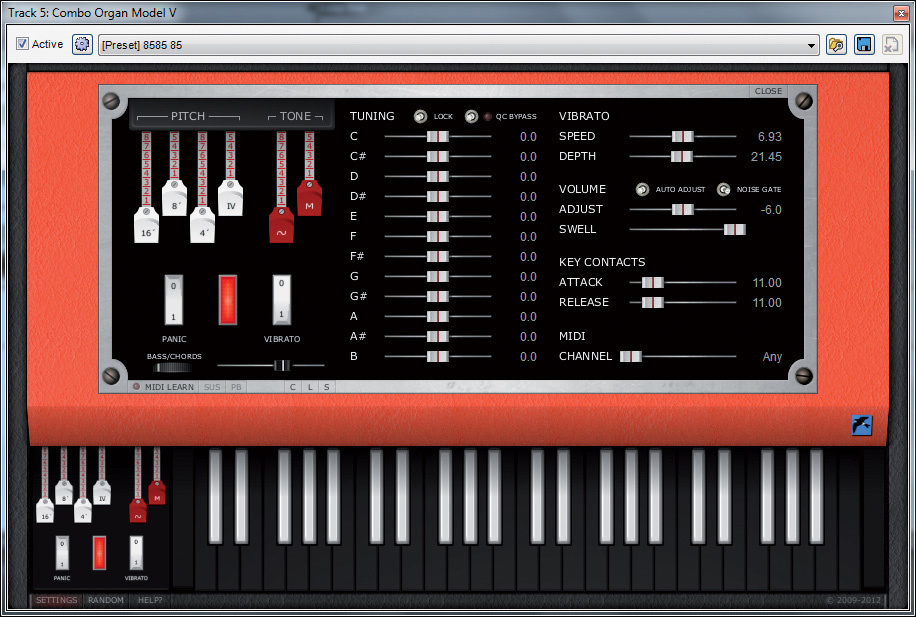 These are nicely done and take plenty of graphic symbol, although information technology'due south perhaps worth noting that both are bachelor as free downloads, independent of Mixcraft, from the original developer's web site at www.martinic.com. New effects include EZQ, an like shooting fish in a barrel-to-apply equaliser, and Broadcast Processor, a basic multi-band compressor (both originally hailing from www.toneboosters.com).
The Pro Studio parcel includes all of the above, plus a number of other new effects. Acoustica themselves provide a very flexible 31-band graphic EQ and a nice, smooth-sounding new reverb.  GSXL4070 is a vintage-style parametric EQ licensed from Yard-Sonique, who are besides responsible for the FAT+ analogue overdrive/tape saturation plug-in. ToneBoosters' Ferox does a similar job to FAT+, focusing on tape emulation specifically.
Another nice perk of the Pro Studio bundle is the Mastering Essentials multi-effect from Izotope.  Based on technologies borrowed from their Ozone production, Mastering Essentials combines a Room Simulation reverb, a four-band valve EQ emulation, and a 'tube amplifier module' comprised of compressor, limiter and saturation effects. Designed for utilize across whole mixes, these furnishings are designed to add a professional 'sheen' to your finished recordings. Lots of useful presets are included, and it's easy to come up with good-sounding results quickly.
Other plug-ins include an envelope follower, a stereo enhancer, a 'stereophase filter' (for odd, pseudo-panning effects), a noise gate, another parametric EQ, and a bit crusher. Many of these either are or take been bachelor in i form or another elsewhere; still, together they amount to a comprehensive collection from which little could be said to be missing.
Pros
- Numerous pocket-size improvements, with no meaning price hike.
- Extensive plug-in bundle.
- Large and usable sound library.
Cons
- Interface can feel crowded on smaller displays.
Summary
Acoustica take fabricated numerous modest refinements to Mixcraft without sacrificing its prized ease of use. The standard version, in detail, remains excellent value for money.
information
Pro Studio download $149.95; Mixcraft 6 $74.95 (download) or $84.95 (boxed).
Pro Studio download $149.95; Mixcraft vi $74.95 (download) or $84.95 (boxed).
Test Spec
- Mixcraft Pro Studio 6.0 (build 196).
- two.1GHz Intel dual-core laptop with 2GB RAM, running Windows vii SP1.
Mixcraft 6 for Mac Free Download
Posted by: waltonprisses.blogspot.com

